Buying a home in Rotterdam without interest: the 2026 figures
What a Rotterdam home costs, district by district, and why interest-free financing changes the arithmetic here. Sources and valuation dates attached.
·9 min read
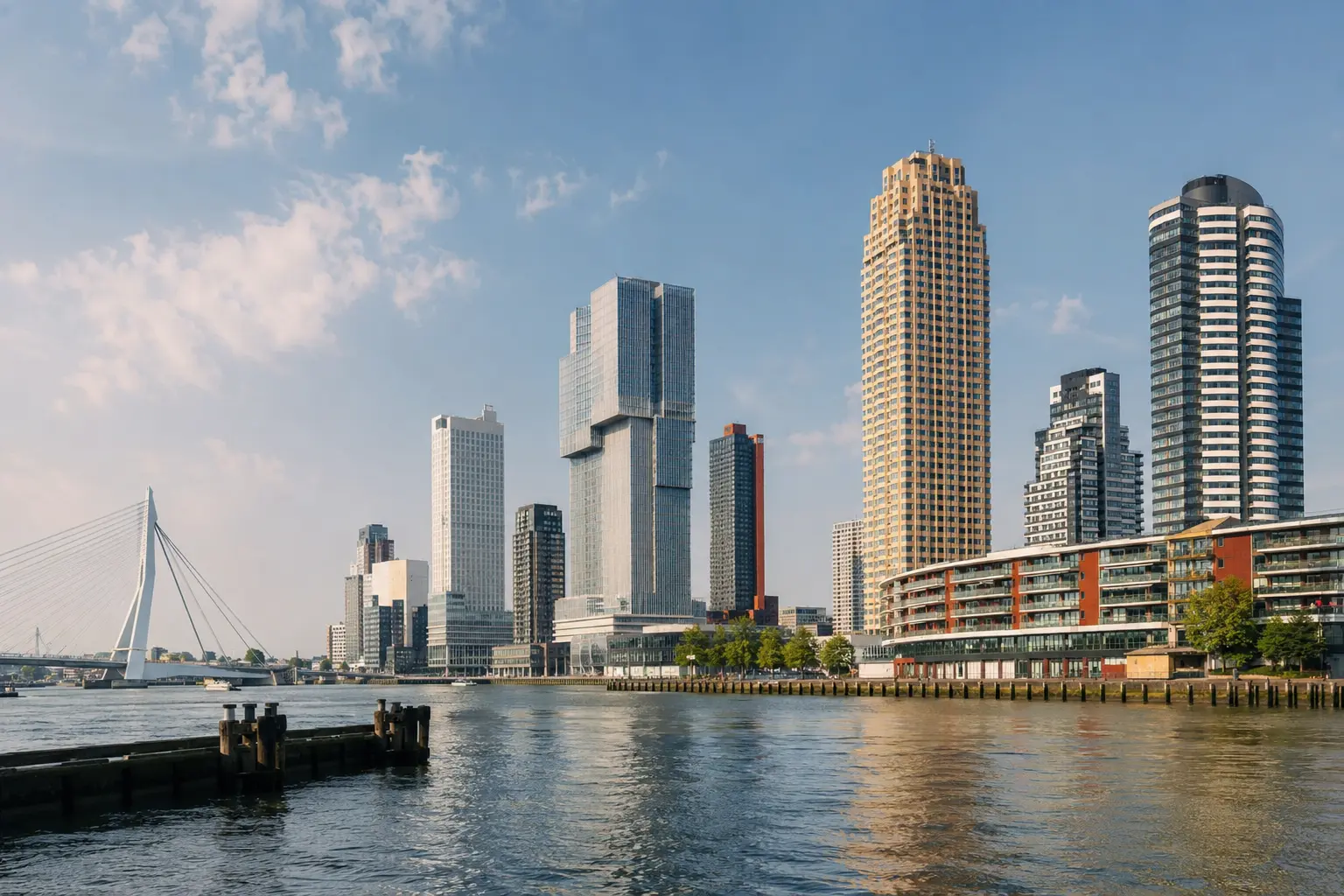
An existing owner-occupied home in Rotterdam cost an average of €422,154 in the second quarter of 2026 — €67,866 below the national average of €490,020. That figure carries the rest of this article: at that price the average Rotterdam home stays under the NHG ceiling, while the average Dutch home rises above it. Anyone financing without interest then meets two tax obstacles that no house price includes.
What a Rotterdam home costs in 2026
Every figure below comes from CBS table 85792NED, built on the Land Registry's notarial deeds and last updated on 22 July 2026. It covers existing owner-occupied homes bought by a private individual.
| Indicator | Rotterdam | Netherlands |
|---|---|---|
| Average sale price | €422,154 | €490,020 |
| Price index (2020 = 100) | 146.2 | 154.9 |
| Price change year on year | +3.2% | +4.2% |
| Homes sold in the quarter | 1,992 | 58,952 |
| Owner-occupied share of stock | 35.0% | 57.4% |
Two things stand out. Rotterdam has trailed the national price rise in every recent quarter, and cumulatively since 2020 by almost nine percentage points. And it remains a renting city: 35.0% of homes are owner-occupied against 57.4% nationally.
Why every source gives a different figure
Search for the average Rotterdam house price and you will find numbers hundreds of thousands of euros apart. Not because anyone is wrong, but because three different things are being measured.
- Which homes. The CBS average of €422,154 covers all dwelling types. A figure counting only family houses runs far higher in a city that is three-quarters apartments.
- Which moment. CBS and the Land Registry measure at registration of the deed. The estate agents' association measures at signature of the purchase contract, on average two to three months earlier. In a rising market the same quarter diverges.
- Which value. The WOZ value is a tax assessment, not a sale price, and its valuation date is a year earlier.
For Rotterdam itself the agents' association publishes no separate figure: its data covers the Groot-Rijnmond region, fifteen municipalities together, with a median sale price of €467,000 in the same quarter. That is a different measurement of a different area, and not comparable with the CBS average.
Prices by Rotterdam district
Here the public data stops. Sale prices per Rotterdam district are published nowhere: the city compiles them from agents' figures, but the database is not publicly accessible. What does exist per district is the WOZ value.
Read the table as a ranking, not a price list. These are WOZ values from the 2025 district statistics, with a valuation date of 1 January 2024 — more than two years before the sale figures above. The owner-occupied share sits beside it because in a city that is 65% rented, it determines whether anything is for sale at all.
| District | Avg. WOZ | Owner-occupied |
|---|---|---|
| Hillegersberg-Schiebroek | €496,000 | 54% |
| Centrum | €424,000 | 27% |
| Overschie | €413,000 | 51% |
| Kralingen-Crooswijk | €395,000 | 26% |
| Hoek van Holland | €381,000 | 43% |
| Prins Alexander | €360,000 | 44% |
| Noord | €359,000 | 35% |
| Delfshaven | €325,000 | 28% |
| Feijenoord | €311,000 | 22% |
| Pernis | €303,000 | 73% |
| Hoogvliet | €298,000 | 46% |
| Rozenburg | €293,000 | 55% |
| IJsselmonde | €267,000 | 38% |
| Charlois | €240,000 | 29% |
| Rotterdam total | €342,000 | 35% |
The spread is wide: Hillegersberg-Schiebroek sits at more than double Charlois. And the two columns do not move together. Pernis has the highest owner-occupied share in the city at 73% on a WOZ well below average, while Centrum and Kralingen-Crooswijk combine high values with an owner-occupied share of around a quarter.
Why interest-free financing changes the sum
Up to here this is about the housing market. From here it is about financing, and the proportions change.
An interest-free structure carries no interest, and Dutch mortgage interest relief applies only to interest. The financier also usually takes ownership of the property first, which can bring transfer tax a second time. We work through both obstacles, with the statutory articles, in what a halal mortgage costs under Dutch tax law.
The effect on what you can buy in Rotterdam is direct. On a qualifying income of €50,000, the lending standards allow 24.6% of income toward financing costs where the interest is deductible, and 17.4% where it is not. That is almost thirty per cent less room, against the same prices as in the tables above.
NHG, and why the Rotterdam average falls just under it
The NHG ceiling for 2026 is €470,000, or €498,200 where energy-saving measures are financed alongside, at a guarantee fee of 0.4% of the principal.
There is a number in that which favours Rotterdam. The average existing home in the city costs €422,154 and stays €47,846 under the ceiling. The national average of €490,020 sits €20,020 above it. On average, then, a Rotterdam home can still be financed with NHG and an average Dutch home cannot.
Whether NHG can be granted on an interest-free structure is another question, and no public answer exists. We searched the 2026-1 Conditions and Standards for halal, islamitisch, rentevrij, renteloos, sharia and huurkoop and found no occurrence of any of them. The conditions assume a first-ranking right of mortgage and monthly interest and principal. That makes it hard to fit, but it is our inference from the text, not a position taken by NHG.
Transfer tax: what changed in 2026
The rates are in article 14 of the Legal Transactions (Taxation) Act, and one was added this year that many published overviews still miss.
- 0% for a first-time buyer: of age, under 35, not having used the exemption before, going to live there, and the home no more than €555,000.
- 2% where you will use the home as your own main residence.
- 8% for a home you will not occupy yourself. This rate did not exist before 2026 — through 2025 it was 10.4%.
- 10.4% for everything else.
At Rotterdam's average of €422,154 the first-time-buyer exemption stays comfortably in reach: the ceiling is €132,846 higher. Note that the value of the whole home counts, not your share. Two buyers under 35 who together buy a €600,000 home get nothing, even split equally.
Opkoopbescherming is not a ban on buying
This is widely misreported, so precisely: opkoopbescherming does not stop you buying. It stops you letting the home out, without a permit, for the first four years after the deed is registered. The basis is chapter 7 of the Housing Act 2014.
Rotterdam applies it in sixteen districts, to homes with a WOZ value below €470,000 — the WOZ value, not the purchase price, so a home with a higher market value can still fall under it. The city aligned that ceiling with the NHG limit for 2026 and indexes it annually.
The sixteen districts are Bergpolder, Blijdorp, Bloemhof, Carnisse, Groot IJsselmonde, Het Lage Land, Hillegersberg-Zuid, Hillesluis, Kralingen-Oost, Kralingen-West, Middelland, Nieuwe Westen, Oud Mathenesse, Oud-Charlois, Rubroek and Tarwewijk.
If you are going to live there, none of this touches you. Letting without a permit carries a €21,750 fine; a permit application costs €327.70 in 2026. Exceptions include letting to a first- or second-degree relative.
The Rotterdam Act applies to renters, not buyers
The second rule wrongly charged to buyers. The Urban Areas (Special Measures) Act lets municipalities screen housing applicants in designated areas. Rotterdam applies only the police-records screening, in 25 streets, covering 7,473 rental homes.
The municipal housing access regulation states in article 2 that it applies to accommodation offered for rent, and its explanatory notes make it explicit: that means homes which are not owner-occupied. The city itself writes that anyone who buys a home and will live in it needs no housing permit. The income requirement from the older regulation is no longer applied in Rotterdam either.
What comes on top of the purchase price
Buyer's costs in the Netherlands run to roughly 4 to 5 per cent of the purchase price. Part of that is a statutory tariff and the rest is a market rate — a distinction worth making, because you can negotiate the second and not the first.
| Item | Amount | Type |
|---|---|---|
| Registering the transfer deed | €103.50 | Statutory |
| Registering the mortgage deed | €103.50 | Statutory |
| NHG guarantee fee | 0.4% of principal | Fixed by NHG |
| Notary (both deeds) | around €1,300 | Market rate |
| Valuation, NWWI-validated | €600 – €900 | Market rate |
| Mortgage advice and brokerage | €1,500 – €3,000 | Market rate |
The Land Registry tariffs were not raised for 2026: €103.50 per deed applies to electronic filing and is unchanged from 2025. An interest-free structure often involves a second deed, in which case those items count twice.
What is and is not known about Rotterdam's Muslim community
CBS publishes no figures on religion at municipal or district level. There is therefore no published number for how many Muslims live in Rotterdam or in any Rotterdam district, and we do not give one.
What CBS does publish is country of origin, which is a different thing and says nothing about faith. Most Rotterdammers with an origin outside Europe live in Feijenoord, Delfshaven, Charlois and IJsselmonde. Set against the table above, those are also the districts with the lowest WOZ values and the lowest owner-occupied shares in the city. The figures justify that observation and nothing beyond it.
Sources and method
Sale prices, price index and transactions: CBS 85792NED, last updated 22 July 2026, built on Land Registry data. WOZ values and owner-occupied share by district: CBS 86165NED, 2025 district statistics, valuation date 1 January 2024. Tenure: CBS 86286NED at 1 January 2025. Regional figures: NVM market report for Groot-Rijnmond, second quarter 2026. Statutory texts were read in the version in force on 7 September 2026.
We update this article every quarter, as soon as CBS publishes new figures. If something is wrong, tell us through the corrections page.
Further reading: what a halal mortgage costs under Dutch tax law, the structures compared, and what to look for in a provider.
About this site
What does a home in Rotterdam cost on average?
An existing owner-occupied home in Rotterdam cost an average of €422,154 in the second quarter of 2026 (CBS table 85792NED). That is €67,866 below the national average of €490,020. In the same quarter 1,992 existing owner-occupied homes were sold in Rotterdam.
Can I get NHG on a halal mortgage?
There is no public answer. The NHG ceiling for 2026 is €470,000, but the 2026-1 Conditions and Standards nowhere mention halal, Islamic, interest-free or huurkoop. The conditions assume a first-ranking right of mortgage and monthly interest and principal, which makes an interest-free structure hard to fit. NHG has published no position on this.
Does the first-time-buyer exemption apply to an interest-free structure?
The exemption sets conditions on the acquirer: of age, under 35, not having used it before, and going to use the home as their own main residence, with a value up to €555,000. Those conditions apply per acquisition. Where a financier takes ownership first, that acquisition fails the main-residence condition and is taxed at 8%.
Does opkoopbescherming affect me as a buyer in Rotterdam?
Only if you intend to let the property. Opkoopbescherming forbids letting without a permit for four years after the deed is registered, in sixteen Rotterdam districts, where the WOZ value is below €470,000. If you are going to live there yourself, no permit is needed. Letting without one carries a €21,750 fine.
Does the Rotterdam Act apply if I buy a home?
No. Article 2 of the municipal housing access regulation applies only to accommodation offered for rent, and the explanatory notes state explicitly that this means homes which are not owner-occupied. The city writes that anyone who buys a home and will live in it needs no housing permit.
Why do the house prices I see online differ so much?
Because three different things are being measured: which homes are counted (all types, or only family houses), at what moment (registration of the notarial deed, or signature of the purchase contract two to three months earlier), and which value is used (a sale price, or a WOZ tax assessment with a valuation date a year earlier).