Murabaha, Musharaka or Ijarah: which structure suits you?
Three structures that all avoid interest, but differ fundamentally in how they distribute risk and where they came from. And why only one of them counts as shariah based.
·4 min read
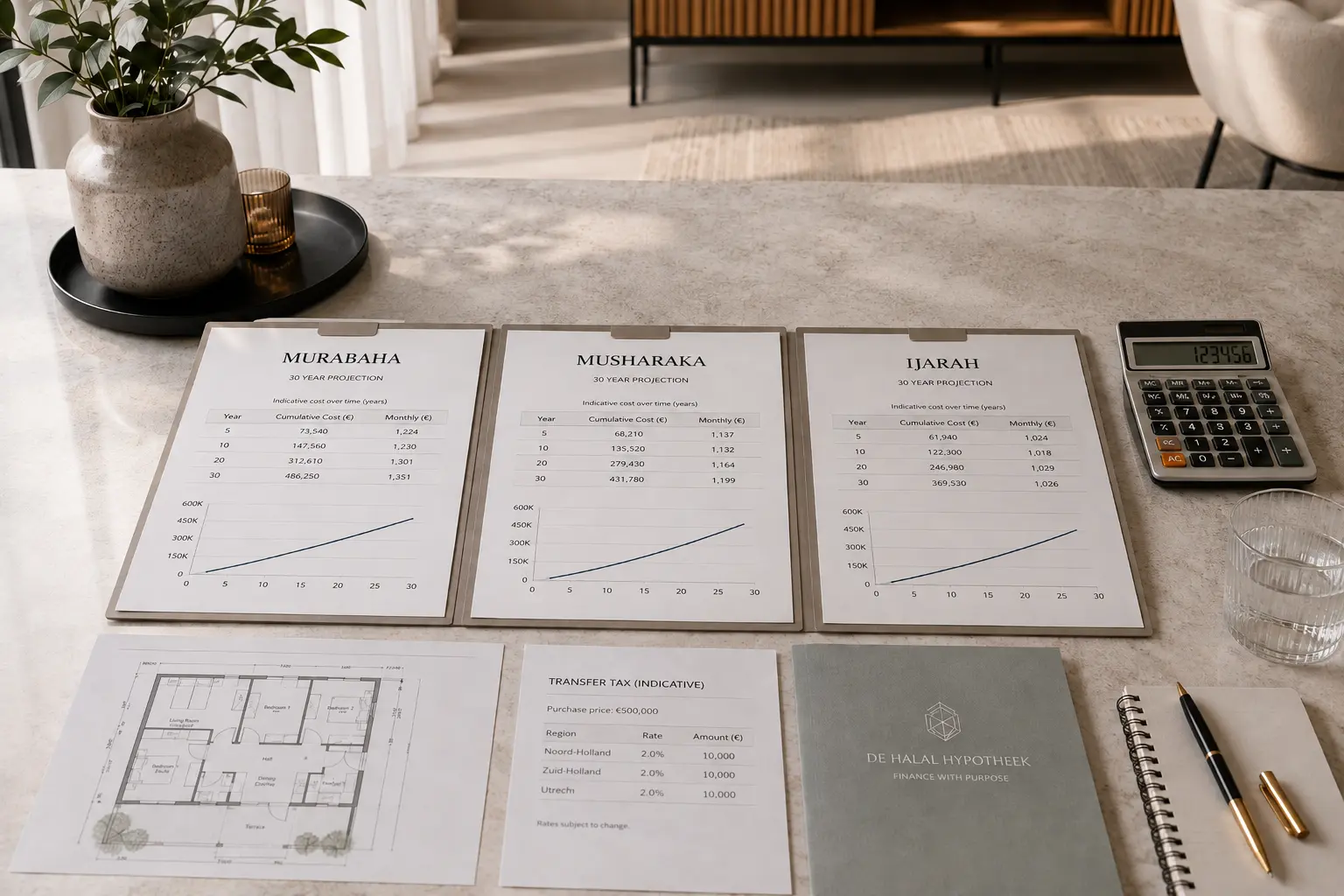
Islamic finance has no single, uniform halal mortgage. Several structures have been developed, all of them aiming to avoid interest and to tie financing to real economic activity. They differ substantially, however, in philosophy, in the distribution of risk, and in origin.
The three forms most used for home financing are Murabaha, Musharaka and Ijarah wa iqtina. To understand them properly it is essential to distinguish between shariah based and shariah compliant financing. That distinction goes to the heart of Islamic finance and largely determines how pure a given structure is considered to be.
Shariah based versus shariah compliant
Shariah based financing rests on genuine risk sharing. The parties participate jointly in an asset and share both profit and loss. There is no predetermined return and no economic guarantee for either party.
This approach aligns most directly with the underlying ethics of Islamic law. The classical and in practice only shariah based form of home financing is Musharaka.
Shariah compliant financing, by contrast, covers structures that were not originally developed as financing instruments but were later applied to offer an alternative to interest-based products within modern financial systems. Murabaha and Ijarah wa iqtina fall under shariah compliant financing.
The difference is therefore one of principle. Shariah based starts from partnership and shared entrepreneurial risk. Shariah compliant starts from existing legal forms, arranged so that they remain within the bounds of shariah.
| Diminishing musharaka | Murabaha | Ijarah wa iqtina | |
|---|---|---|---|
| Legal form | Joint ownership | Sale with deferred payment | Lease with transfer of ownership |
| Owner during the term | Buyer and financier together | The buyer, immediately on delivery | The financier |
| Financier carries owner's risk | Yes, throughout | No, only until delivery | Yes, throughout |
| Return fixed in advance | No | Yes, contractually | Yes, through the rent |
| Financier shares in appreciation | Yes | No | Yes |
| Classification | Shariah based | Shariah compliant | Shariah compliant |
Musharaka
Musharaka is a partnership in which buyer and financier jointly own the property. Both parties contribute capital and share in the ownership.
In practice a diminishing Musharaka is common. The buyer acquires the financier's share step by step. For the portion not yet owned, the buyer pays a fee for use.
The defining element of Musharaka is genuine risk sharing. The financier is exposed to changes in the value of the property and carries ownership risk for as long as they are a co-owner. There is no guaranteed return separate from the underlying asset.
Within Islamic finance, Musharaka is regarded as the purest form of halal financing, precisely because ownership, risk and return are inseparably bound together.
Murabaha
Murabaha is a purchase arrangement with deferred payment. The financier buys the property and resells it to the buyer at a higher price agreed in advance. That price includes the financier's profit margin and is fixed when the agreement is concluded. The buyer pays the purchase price in instalments.
There is no interest, because the return arises from a sale transaction rather than from making money available.
Murabaha does not, however, involve structural risk sharing. After delivery the economic risk sits entirely with the buyer. The financier's return is fixed by contract and does not depend on how the value of the property develops. For that reason Murabaha is classified as shariah compliant.
Ijarah wa iqtina
Ijarah wa iqtina is a lease arrangement in which ownership ultimately passes to the tenant. The financier buys the property and leases it to the occupant.
The occupant pays periodic rent for the use of the property. Alongside the lease it is agreed that the property will in time become the tenant's own.
During the lease period the financier remains the legal owner and carries the ownership risks that come with it. Ijarah wa iqtina is therefore also regarded as shariah compliant.
Further reading: why interest is the problem, what an interest-free structure costs under Dutch tax law, and what to look for in a provider.
Deep Dives
Is a mortgage haram? The prohibition on interest explained
Why a conventional mortgage collides with the Islamic prohibition on riba, and how a halal mortgage resolves it differently. Not a religious label, but a different distribution of ownership, risk and return.
·3 min read

The principles of Islamic finance
Riba, gharar, maysir and risk sharing. The rules every halal financing structure rests on, and why they exist.
·3 min read