Is a mortgage haram? The prohibition on interest explained
Why a conventional mortgage collides with the Islamic prohibition on riba, and how a halal mortgage resolves it differently. Not a religious label, but a different distribution of ownership, risk and return.
·3 min read
A halal mortgage is a form of home financing arranged according to the principles of Islamic finance. It is intended for people who want to buy a home without acting against the Islamic prohibition on interest. That leads to a fundamentally different legal and economic structure than a conventional mortgage. It is not a religious label, but a different distribution of ownership, risk and return.
The prohibition on interest in Islamic finance
Islamic finance applies a strict prohibition on riba. Riba is often translated as interest, but its meaning is broader. It covers every form of guaranteed or predetermined return on money where there is no real economic risk or tangible consideration in exchange.
The underlying principle is that money may not be a commodity. Money may serve only as a medium of exchange. Profit is permitted only where it arises from genuine economic activity, such as trade, ownership or entrepreneurial risk.
This prohibition is set out explicitly in the Qur'an. In surah Al-Baqara, interest is sharply condemned and expressly distinguished from permitted trade. In the traditions of the Prophet Muhammad, riba is likewise forbidden without reservation, regardless of its size or the intention behind it.
From a financial and economic perspective, the prohibition addresses an imbalanced distribution of risk. With interest, the lender receives a fixed return while the entire risk sits with the borrower. Islamic finance starts instead from the principle that risk and return must be bound to one another.
Why a conventional mortgage is not halal
A conventional mortgage is based on a loan of money on which the bank receives interest. That interest is fixed and does not depend on how the value of the property develops or on the buyer's financial situation.
The bank also remains legally outside the ownership of the property. The property serves purely as security. The result is an arrangement in which money itself is traded for a fixed return, which Islamic finance does not permit.
What makes a halal mortgage different
A halal mortgage avoids interest by basing the financing on ownership, use or partnership. The financier does not extend a loan at interest, but participates in the property as a real asset in another way.
In practice, the structures used include:
- Purchase with deferred payment, where the property is resold in instalments at a price agreed in advance;
- Lease arrangements where the financier remains the owner and the occupant pays rent, often combined with a gradual transfer of ownership;
- Partnership arrangements where buyer and financier own the property jointly and the financier's share is bought out step by step.
The financier's return consists of trading profit, rental income or a share in the value of the asset. Not interest on money. Every term is agreed in advance and tied to a concrete, tangible asset.
Conclusion
A halal mortgage is not an adapted version of a conventional mortgage but a fundamentally different way of financing. The prohibition on interest is the starting point, and it leads to structures in which ownership, risk and return are distributed differently.
For homebuyers this offers a form of financing that aligns with Islamic values while sitting within the Dutch legal system. For providers it demands a considered and durable legal and financial design.
Further reading: the principles behind the prohibition, how the structures differ, and what it costs under Dutch tax law.
Deep Dives
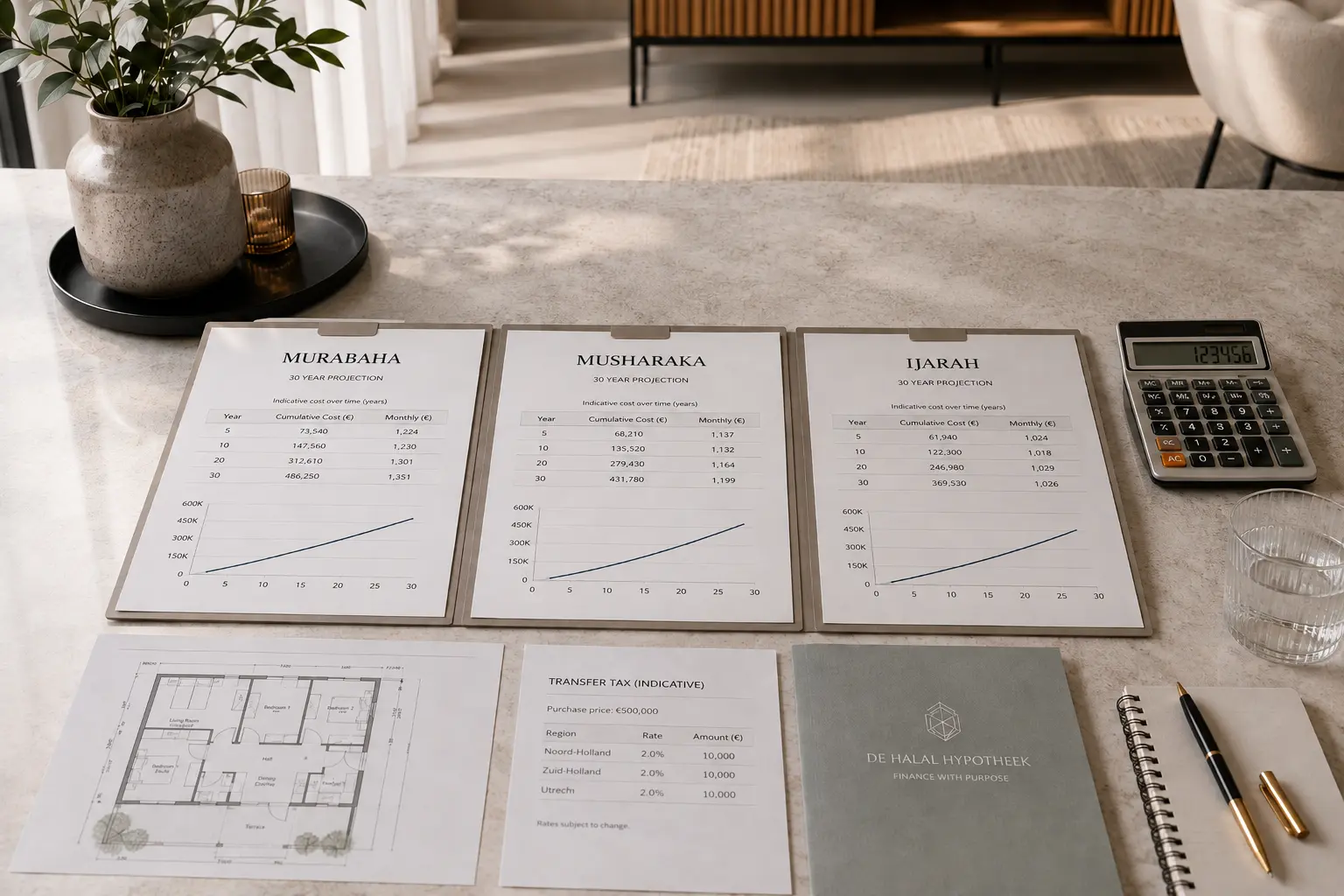
Murabaha, Musharaka or Ijarah: which structure suits you?
Three structures that all avoid interest, but differ fundamentally in how they distribute risk and where they came from. And why only one of them counts as shariah based.
·4 min read

The principles of Islamic finance
Riba, gharar, maysir and risk sharing. The rules every halal financing structure rests on, and why they exist.
·3 min read